
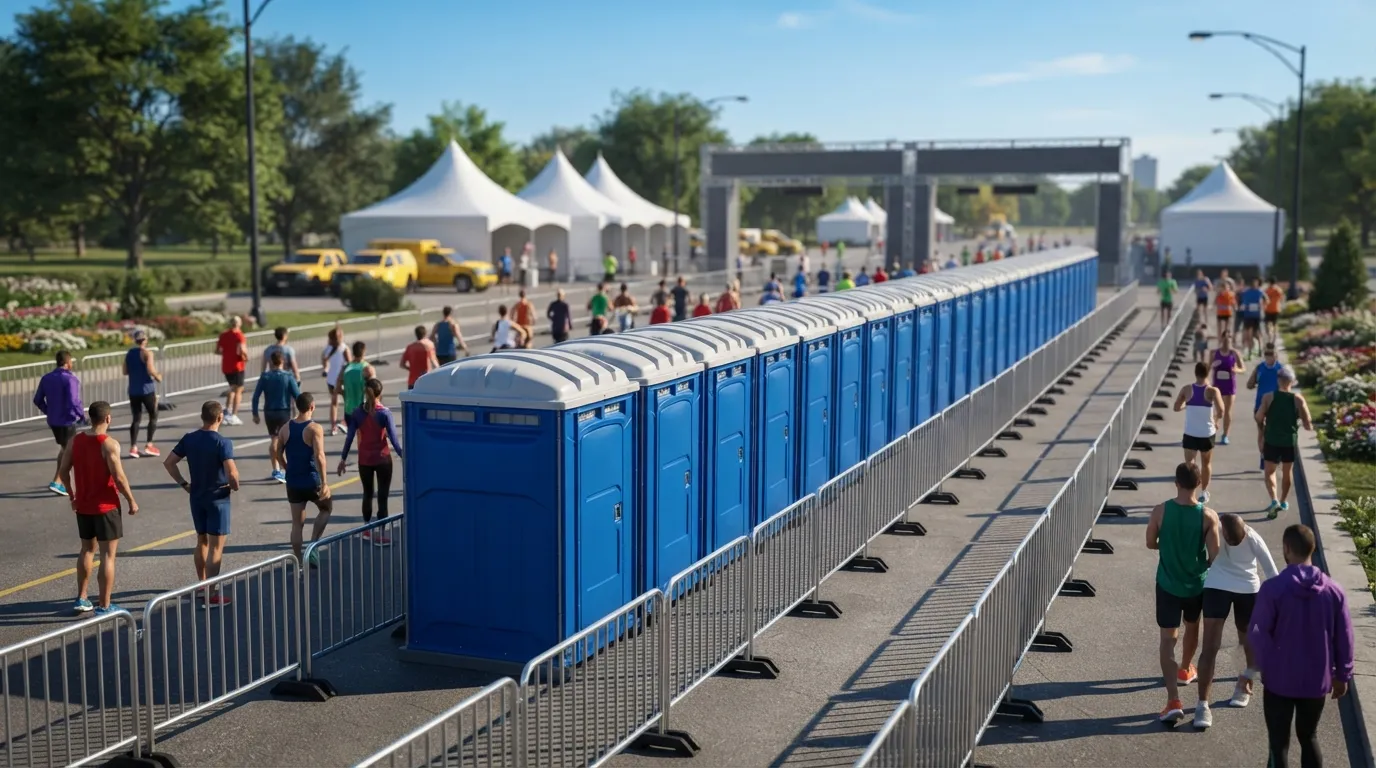
How many restrooms does a race need?
Start with the crowd, not the course. A start/finish corral holding 800 runners plus 200 spectators needs a real cluster of standard porta potty rental units, not a token two or three. ANSI/PSAI Z4.3 sets the baseline service interval at one visit per week for 10 users over a 40 hour week, but a race compresses thousands of uses into a few hours, so race-day density has to be planned separately from that baseline. Aid stations at mile markers usually get one or two units each, spaced for the runners passing through, not the runners waiting.
ADA Standards section 213.2 requires that where single-user units are clustered, at least 5 percent be accessible, with never fewer than one. That means your start line cluster and your finish line cluster each need their own ADA accessible porta potty, not one unit shared across the whole course. We also route in an event restroom rental package for VIP or sponsor tents, and a deluxe flushable porta potty reads better in photos near a finish arch. For a course that spans Moreno Valley and edges toward March ARB, 7.4 miles southwest, plan restroom clusters at both ends rather than one central bank runners have to detour to reach.
Timing tables, water stations, and a results tent draw crowds that behave like a small festival. If your race shares a weekend with a community event, check our festival restroom rental page for how those layouts differ from a straight running course.
Do we need handwashing stations at aid stations?
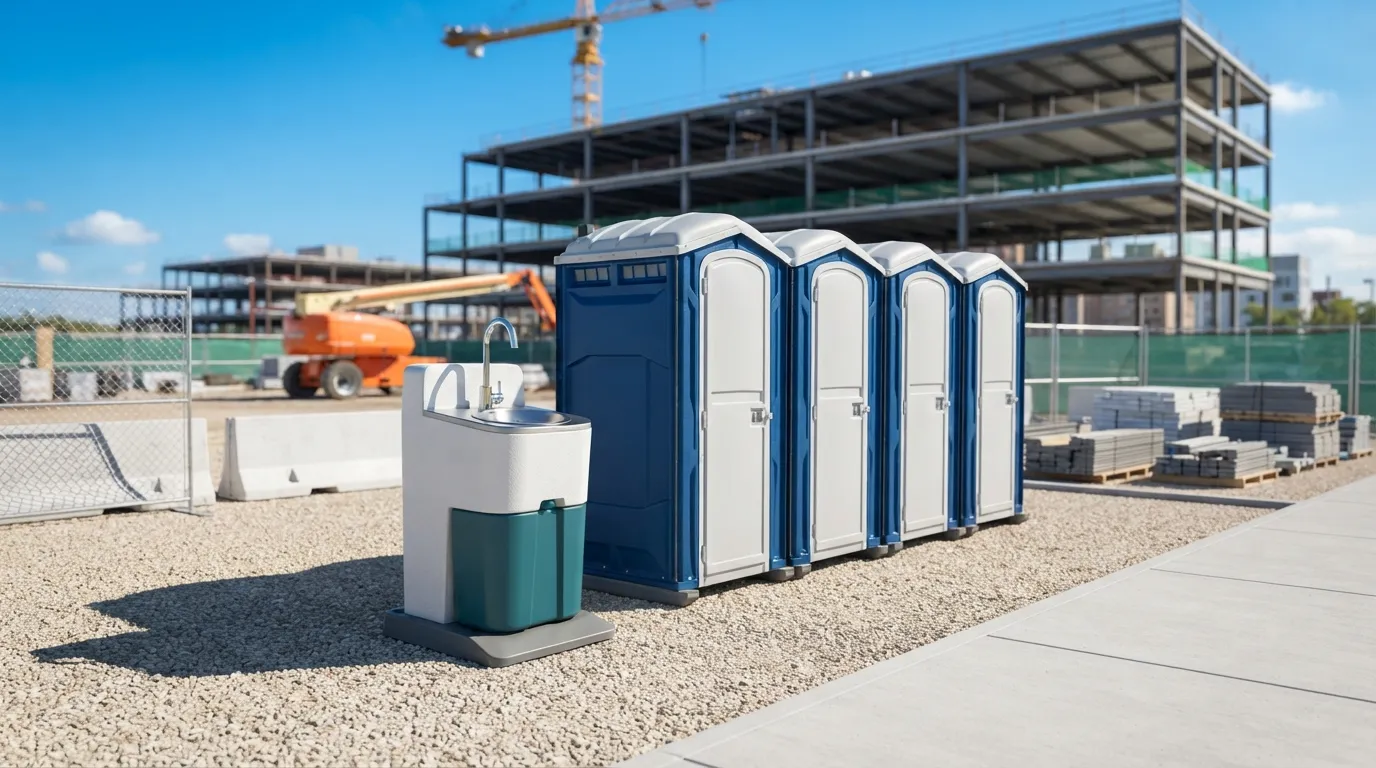
Yes. Aid stations hand out water, gels, and sometimes food, and OSHA 1926.51(a)(1) requires an adequate supply of potable water at any place of employment, which covers your volunteer and staff stations even on race day. Pair each aid station's toilets with a handwashing station rental unit. 29 CFR 1910.141(d)2) requires soap and towels or a hand-drying device at wash stations; hand sanitizer alone does not satisfy it, so do not swap one for the other and call it done.
If your course includes a section treated with herbicide by the parks department shortly before race day, OSHA 1926.51(f)(1) requires washing facilities specifically for contact with herbicides, coatings, paints, or insecticides. That is a narrow trigger, but it matters if course markers were freshly painted. A simpler fix is a portable sink rental at the volunteer check-in tent, where hands touch timing chips, snacks, and cash all morning.
Lighting matters too if your race starts before sunrise. OSHA 1926.56(a) sets minimum illumination levels for work areas, and a pre-dawn start corral in Moreno Valley benefits from a light tower rental near the restroom bank so volunteers and runners can actually find the doors.
How do we handle power for timing and sound at the start line?
Timing systems, PA speakers, and results laptops need steady power, and most races run a generator or a temporary power pole near the start/finish line. Knowing how to brace a temporary power pole matters here: guy it at three points spaced evenly around the pole, anchor each guy line at roughly a 45 degree angle to the pole's height, and keep the base clear of the runner corral and any barricade line. OSHA 1926.404(b)(1)(ii) requires GFCI protection on construction-site power circuits, and it's worth applying the same standard to race-day power even though a road race isn't a construction site, because wet grass and extension cords are a bad mix.
Barricades along the course should follow OSHA 1926.202, which calls for barricades conforming to ANSI D6.1, mainly relevant where your course crosses vehicle traffic. Pair barricade lines with crowd control barrier rental at the finish chute, and if any portion of the course needs to be closed to foot traffic before or after the race, a temporary fence rental section does that cleanly. Runners driving in from Loma Linda, 15.4 miles north, or Colton, 16.5 miles northwest, will be looking for clear signage at the restroom clusters, so keep placement visible from the corral.
For race weekends near Yucaipa, 17.2 miles northeast, or Jurupa Valley, 19.0 miles west, confirm restroom placement in any public right-of-way with the city before delivery day; that permission is not something we can confirm from here, only Moreno Valley's own review can settle it. Our porta potty placement guide covers ground clearance and surface stability if your finish line sits on grass or gravel.
How much does restroom rental cost for a race?
A standard unit for an event day runs from about $200 to $800, and an ADA unit for a single day runs about $200 to $400. Multi-unit race packages usually price closer to the event-day band than the single-day rate. Check porta potty rental cost for the full breakdown by unit type.
How far in advance should we book race restrooms?
Book as soon as your course map and permit are close to final, ideally weeks out. Race weekends compete with construction and other events for the same fleet, so early requests get first pick on unit count and ADA placement. Use request a quote to lock dates.
Can we get restrooms delivered the morning of the race?
Usually not reliably for a first-time request; race-day delivery windows are tight and traffic control matters. If you're already close to race day, call our emergency porta potty rental line and we'll tell you honestly what's possible.
Do aid stations need their own restrooms or just the start/finish?
Aid stations need their own units, especially on longer courses. Runners won't backtrack to the start line mid-race, and clustering everything at one end leaves half your course without coverage. Space units by mile marker and expected pace groups.
What is the difference between race restrooms and festival restrooms?
Races move; festivals stay put. A race needs restrooms spread across a route with runners passing briefly, while a festival needs a fixed cluster serving people who linger for hours. See festival restroom rental for that different layout logic.
Next step
Get a delivery date
Tell us the address, the dates and the headcount. We size the order and confirm the route.